

The Future of Creative Strategy Isn't a 40-Hour Work Week. It's 4.
Feb 20, 2026
|
5
min read
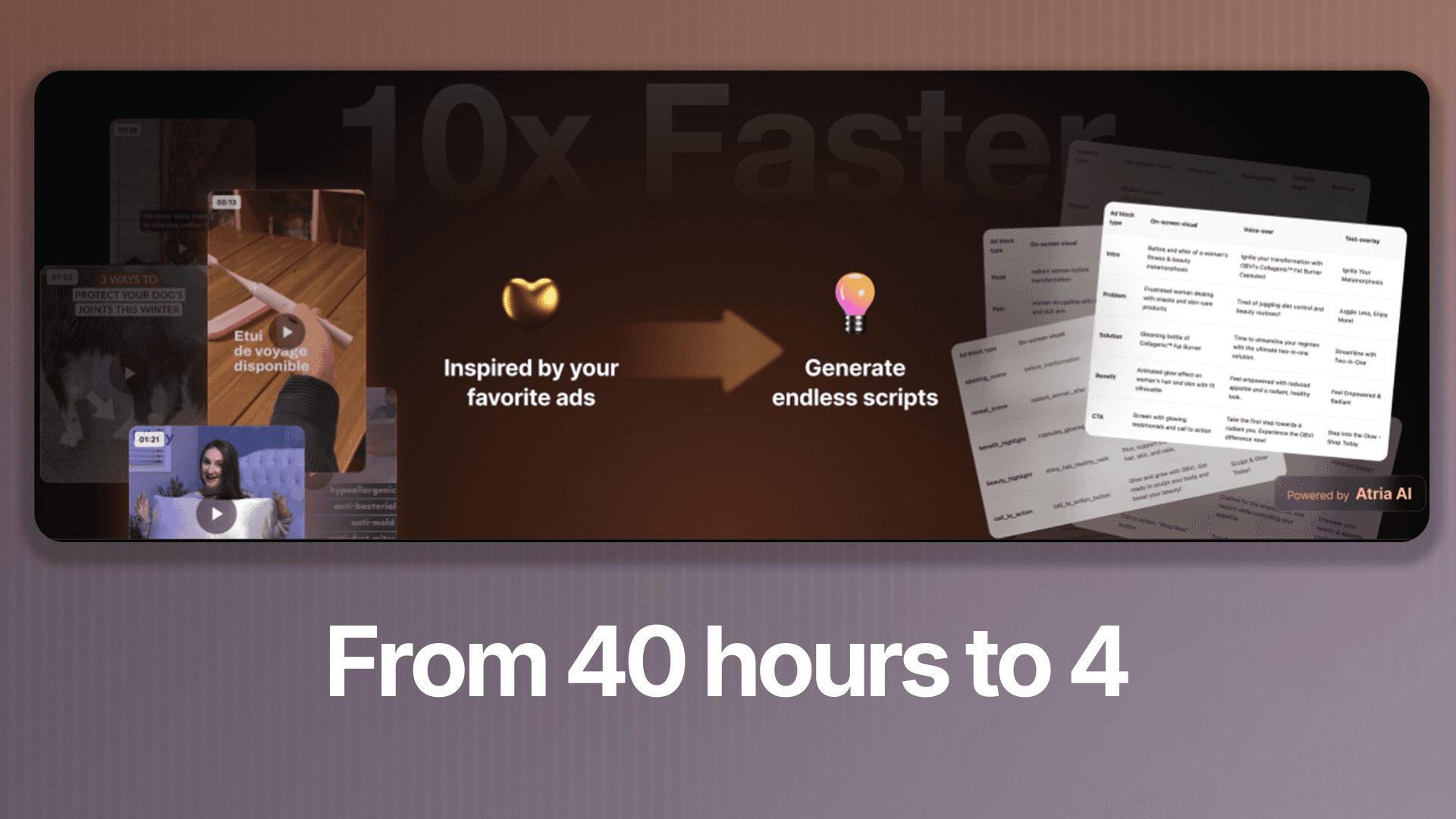
This is the first in a series of POV pieces from Ad Signal, a private community bringing together the brightest minds in performance marketing to debate the ideas shaping where the industry is headed. Each piece is built around a single belief worth arguing about.
Ad Signal is hosted by Atria (Curious to learn more about Atria? Book a call with us.).
Performance marketing is at an inflection point.
On one side: platforms like Meta with an insatiable appetite for creative, demanding more volume, more variation, more velocity than any human team was built to sustain. Brands like Kitsch are launching 3k+ creatives every month with just a handful of creative strategists. Orbitkey had to 2-3x their creative volume last year, and they’re set to do it again.
On the other: a new generation of AI tools that, in theory, exist to address exactly that problem. And yet most teams are still working the same way they always have. We think that's about to change.
We're talking about shrinking the 40-hour creative work week to 4. Agents are how we get there, but only as fast as teams are willing to rethink how they work.
Let’s discuss where the 40 hours go every week, what we’ve seen teams adopt, and how agents may change the game.
Where the 40 Hours Actually Go
Before we talk about where this is headed, it's worth being honest about where things stand today.
It's Monday morning and the team is already behind. Someone’s still pulling last week's numbers, the winning ad from three weeks ago has stopped converting and nobody knows why, and there's a brief due by end of day that no one has had time to really dig into. So you do what most teams do: you go with your gut, pull some references, and hope the creative team can run with it.
By Wednesday you're in the production loop. Reviewing. Revising. Uploading manually. Chasing approvals. The campaign goes live Thursday, and by Friday you're already doing it again.
Somewhere in that week, there was supposed to be time for actual strategy. For stepping back, looking at the data, forming a real point of view on what to test next and why. It didn't happen. It almost never does. That work gets squeezed into the margins by the relentless operational weight of just keeping up.
The Reality of AI Adoption
Here's where most conversations about AI and creative strategy go wrong: they skip from "AI can do this" to "your team is already doing this" without acknowledging the gap in between.
The reality is that AI adoption in performance marketing is slower and messier than the hype suggests. Most teams have experimented with AI tools, some are using them regularly for specific tasks, and very few have actually restructured their workflow around them in any meaningful way. The tools exist. The integration into how teams actually operate, day to day, brief to brief, campaign to campaign, is still a work in progress for almost everyone.
There are real reasons for this. AI-generated creative still requires significant human review and judgment before it goes anywhere near an ad account. Connecting AI tools to actual performance data in a way that's reliable and actionable takes more technical lift than most teams have capacity for. And honestly, changing how a team works is hard, even when the new way is clearly better.
So the 4-hour creative week is not here yet. But something is shifting that makes it feel genuinely close for the first time.
Why we Think Agents Change the Math
The thing that makes the 4-hour week feel genuinely close right now is agents.
AI tools are things you use when you remember to use them. Agents are already working while you're doing something else. Monitoring your performance data, surfacing what's worth acting on, drafting the brief, generating variations, getting approved creative live — all before you've opened your laptop.
The difference between AI tools and AI agents is the difference between a calculator and an analyst. One speeds up a task. The other takes the task off your plate.
When agents own the research, the analysis, the uploads, and the reporting, what's left for the human team is the work that actually requires a human: the creative instinct, the brand intuition, the call on what to test next. That work doesn't take 40 hours. It takes 4.
But the technology only matters if teams are willing to rethink the workflow around it. That's the harder change.
The Questions Worth Discussing
We don't think this is settled. The shift from 40 hours to 4 raises real questions that the industry hasn't worked through yet:
How much human oversight does AI-generated creative actually need before it's safe to run?
Where does creative judgment end and personal preference begin, and how do you train an agent to know the difference?
If the workflow becomes largely automated, what does a senior creative strategist actually do, and how do you build and develop that talent?
Which parts of the 40-hour week are genuinely automatable, and which ones only feel that way until something breaks?
These are the conversations Ad Signal exists to have. Not hypothetically, but with the people who are actually navigating them right now.
Ad Signal is backed by Atria's analysis of billions of dollars in paid media spend. If you're a founder or senior marketing leader working at the edge of performance creative, you can request an invitation at tryatria.com.