

How to Automatically Score & Turn Underperforming Ads Into Winners (And the Tool That Does It Automatically)
Dec 13, 2025
|
8
min read

You launch a batch of new ads. A few days later, some are tanking. Low click-through rates, poor retention, and burning budget without converting.
The question isn't “Are these underperforming?” That's obvious. The question is: what exactly should you do about it?
Most analytics tools point out the problem. They show you which ads are losing, highlight the metrics, and organize everything into dashboards. But when it's time to fix the underperformer, you're left wondering where to start. Swap the hook? Change the first three seconds? Try a different offer?
That's where AI-powered iteration recommendations come in. It’s what AI was built for: pattern recognition at scale.
Instead of just diagnosing what's broken, these tools analyze your entire ad portfolio to find what your winners have in common, then prescribe exactly what to change in underperformers based on those proven patterns.
Key takeaways
Most tools diagnose, but don't prescribe. Traditional analytics tell you which ads underperform, but leave you guessing what to fix. Prescriptive AI analyzes your winners and gives exact recommendations.
AI scoring cuts through the noise. Instead of debating if 1.2% CTR is good enough, AI grades each ad (A, B-, C+) so you instantly know which underperformers are worth iterating versus killing.
Pattern recognition reveals what winners share. AI identifies patterns across top performers, then flags what underperformers lack, like social proof in the first 5 seconds or question-format hooks.
One-click iteration eliminates waiting. Generate new variants based on AI recommendations without briefing designers or waiting on copywriters.
Faster cycles, better results. Teams using prescriptive recommendations cut iteration cycles from weeks to days, turning underperformers into winners faster than building from scratch.
What makes prescriptive ad creative recommendations different
Prescriptive recommendations analyze your best ads to find patterns, then show you what your underperformers are missing. Instead of telling you "this ad has a low CTR," the system tells you "this ad lacks the social proof element that all your top performers use in the first five seconds."
You need to be able to translate quantitative metrics into qualitative, plain-English insights you can actually act on.
Does an ad deserve another week of testing? Is the hook rate "good enough"?
Instead of wading through performance metrics trying to figure out if a 1.2% CTR is good or bad, you need a way to quickly assess which underperformers have potential and which to kill immediately.
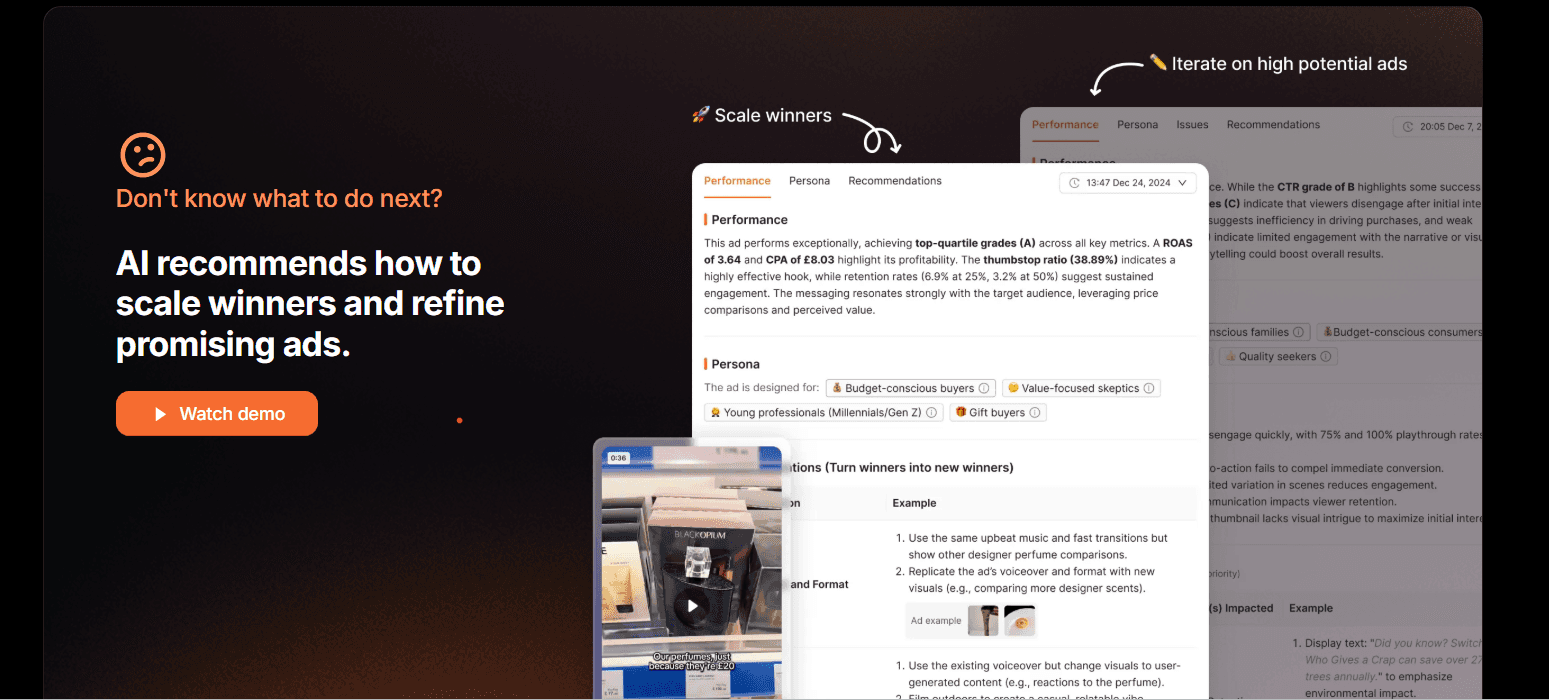
Atria's AI solves this by giving you both layers. First, it automatically grades each ad with letter scores so you can assess priority at a glance. An A-grade ad is a clear winner worth scaling. A C+ grade indicates that there's potential, but specific elements require improvement.
But it doesn't stop there. The AI tells you in plain English: this ad is a C, and here are the three specific changes that would push it to an A. You get the qualitative assessment written out clearly, with all the data breadcrumbs to back it up.
This scoring system, trained on over $1 billion in ad spend data, cuts through the ambiguity that slows down most creative teams.
The AI also analyzes your entire creative portfolio to identify your top-performing ads and the underperformers with high iteration potential. This means you focus on iterating where it'll actually be worth it, rather than wasting time on ads that just aren't good enough to save.
Simon Freeman from Welcome to Digital agency explains how this changes client conversations: “We can quickly see where we're at and identify quick wins. We can show clients: “We know we've got good content, the visuals are great. We just got to change up that hook, and this becomes a great winning ad.”
From insight to execution with one click
Once you have your recommendations, you don't need to jump to another tool to implement them. Atria includes an “Iterate” button that generates new creative variants based on the AI's recommendations.
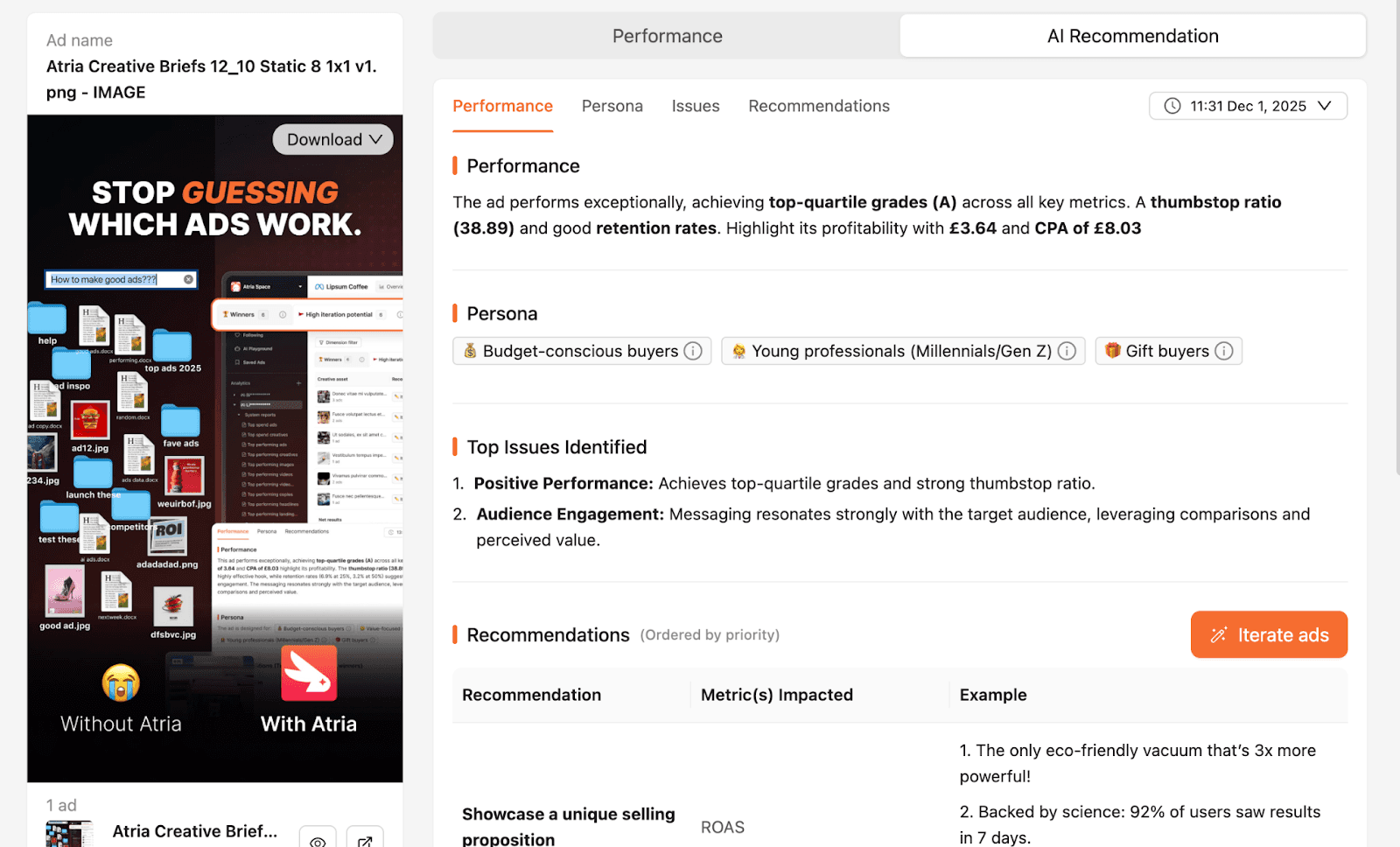
See a suggestion to test a different hook? Click iterate, and the AI generates a new script variation or image asset based on your winning patterns. The iteration happens in the same place as the analysis, cutting out all the context switching that usually slows down testing cycles.
This integrated approach means you can go from “this ad underperforms” to “here's the new variant ready to launch”. No briefing designers, no waiting on copywriters, no back-and-forth revisions. Just quick, data-driven iterations that mirror your proven winners.
See the bigger picture: How tracking angles helps you spot bigger opportunities
Now that you’ve found the low-hanging fruit by looking at your ads one by one, it’s time to zoom out and see what ad angles or concepts are performing best across your whole account.
When you're looking at individual ad metrics, it's nearly impossible to spot which angles are consistently winning. Is it the comparison angle that's working? The testimonial approach? The problem-first structure?
Atria uses AI tagging to automatically group all ads with the same ad concepts, messaging angles, and or emotions.
This lets you see performance patterns across your entire creative ecosystem, not just isolated data points. For example, Atria might tag seven ads as using a "coffee experience" angle.
Grouped together, you instantly see that angle generates $12,000 in spend with 3.2x ROAS, while your "ingredient quality" angle only hits 2.1x ROAS on similar spend. That insight is impossible to spot when analyzing ads individually, and tells you exactly where you should be doubling down in your next experiments.

Your naming conventions become automatic tags. If your team already uses structured ad naming conventions (product name + funnel stage + format), Atria detects that pattern and automatically creates tags from it. New ads get tagged without manual work, saving your teams hours every week of mind-numbing tagging labor.
Coming soon: Custom AI tags. Atria is expanding this capability to let you create your own AI-powered tags for elements unique to your business. You’ll also be able to edit existing tags and build reports around tracking dimensions that matter specifically to your brand.
Maybe all your best-performing ads use comparison angles. Or perhaps your winning hooks all start with a question. These patterns might not be obvious when you're looking at individual ad metrics, but when AI analyzes thousands of data points across your portfolio, they become clear.
Atria cuts ad iteration cycles in half and gets you better results
Speed matters in paid social. The faster you can identify winners and kill losers, the better your overall ROAS. But traditional iteration cycles are slow by nature. You need time to spot the underperformers, time to figure out what to change, time to create new assets, and time to launch and test them.
When you remove the guesswork and give creative teams exact prescriptions instead of general observations, everything moves faster.
Teams using prescriptive recommendations and use AI to iterate quickly typically see their iteration cycles shrink from weeks to days. That acceleration compounds over time. More iterations mean more data, which means better pattern recognition and even sharper recommendations. It's a flywheel that keeps getting faster.
Marin Istvanic, Media Buyer at Inspire Brands Group, said, “Atria is like Foreplay & Motion on AI steroids. Its Radar feature gives you a personal AI creative strategist. It’s really a Swiss Army knife for every marketer.”
Prescriptive vs. descriptive: A side-by-side comparison
You launch eight ad variants to test different angles.
With Motion (descriptive analytics): You see that ads 3, 5, and 8 are underperforming. You analyze metrics, scroll through winners looking for patterns, form hypotheses, and then brief your creative team. Multiply that process by every underperformer. It's time-consuming and relies on your ability to spot patterns.
With Atria (prescriptive analytics): Radar shows the same three underperformers but tells you exactly what to fix:
“Ad 3: Your winning ads introduce the problem in the first 3 seconds. This ad starts with product features. Open with the pain point and move product features to 0:08-0:15.”
“Ad 5: Your top performers include a clear price anchor. This ad says ‘affordable’ without specifics. Add '$X less than [competitor]' in the first 10 seconds.”
“Ad 8: Your winning hooks use questions. This uses a statement. Rewrite it as a question format, like 'Struggling with [problem]?”
Then click the iterate button and generate new variants immediately.
Minimizing wasted spend on creative & making creative testing less risky
One reason teams hesitate to iterate aggressively is risk. When you're making changes based on gut feel, there's always uncertainty. Will this resonate? Could this change make things worse?
Prescriptive recommendations for your ads reduce that risk significantly. You're not taking a shot in the dark. The changes have already proven effective. That doesn't guarantee every iteration will be a home run, but it dramatically improves your odds and give you the data you need to back up your decisions.
This lower-risk environment encourages more testing, which leads to faster learning. Teams become more willing to iterate quickly when they trust that the suggestions are grounded in their own success data rather than generic best practices.
Your iteration cycles get faster, hit rate improves ,and you spend less time staring at dashboards.
That's the promise of AI-powered iteration recommendations. It gives you a clear path to solutions based on what already works for your brand. It's the difference between a diagnostic tool and a strategic partner.