

Best Ad Creative Automation Platforms for 2026 (Top 5 Reviewed)
Dec 22, 2025
|
5
min read
If you're running paid ads in 2025, you've probably already noticed that the old playbook doesn't work anymore.
Five ad variants used to be enough. Now you need 50. Then 500. And your creative team isn’t any bigger than it was last year.
This is where creative automation platforms come in. But, not all of them actually automate your creative workflow. Some are just fancy ad generators that spit out templates. Others promise to handle everything from research to reporting, but fall short on execution.
Let's break down what creative automation actually means, why it matters more than ever, and which platforms are worth your time.
What are creative automation platforms?
Creative automation platforms use AI and workflow tools to speed up ad production. But there's a massive difference between platforms that just generate ads and ones that automate your entire creative workflow.
Ad generators take your inputs (product images, copy, brand guidelines) and create ad variants like really fast designers. You get more ads, faster, but you're still doing all the strategy, research, testing, and analysis manually.
End-to-end creative automation platforms handle the full workflow. They help you research what's working, generate ideas based on data, create the ads, test them, analyze performance, and recommend what to do next. And this amounts to real time savings.
Most platforms fall somewhere in between. Figure out what you actually need before you start tool shopping.
Why creative automation matters more than ever
Here's what changed: Meta's Advantage+ update fundamentally altered how ads work.
Instead of you assigning creatives to audiences, Meta now matches your creatives to individuals. The algorithm looks at someone's behavior, preferences, and context, then serves them the ad variant most likely to convert them specifically.
This is powerful, but it creates a new problem: you need massive creative volume AND diversity to give the algorithm enough options to work with.
We're not talking about going from 5 variants to 10. We're talking 5 to 500. Maybe more.
The catch is that you can't just pump out 500 versions of the same ad with different headlines. That's volume without diversity, and it won't move the needle.
Creative diversity means:
Different formats (static images, carousels, videos, UGC)
Different hooks and angles
Different visual styles
Different messaging frameworks
You need testimonials, product demos, lifestyle shots, user-generated content, before-and-after comparisons, and more. Each one speaks to different pain points, benefits, and audience segments.
Meanwhile, your creative team hasn't magically doubled in size. You're still working with the same headcount, the same budget, and the same hours in the day.
This is the impossible equation that creative automation is trying to solve.
The new impossible task: quantity AND quality
The old creative workflow looked like this:
Brainstorm ideas
Create 5-10 ad variants
Launch and test
Analyze results
Iterate
The new workflow needs to look like this:
Research what's working across your industry
Generate dozens of concepts based on data
Create hundreds of ad variants
Launch and test continuously
Analyze performance in real time
Get AI recommendations on what to iterate
Implement changes immediately
Repeat
Doing this manually at scale is impossible. Even with a big team, you'd spend all your time on production and have no bandwidth for strategy.
Creative automation platforms promise to compress this timeline from weeks to days (or even hours). But which ones actually deliver?
The 5 best ad creative automation platforms
1. Atria
Best for: Ecommerce brands and performance marketers who need data-driven creative strategy and automation at scale
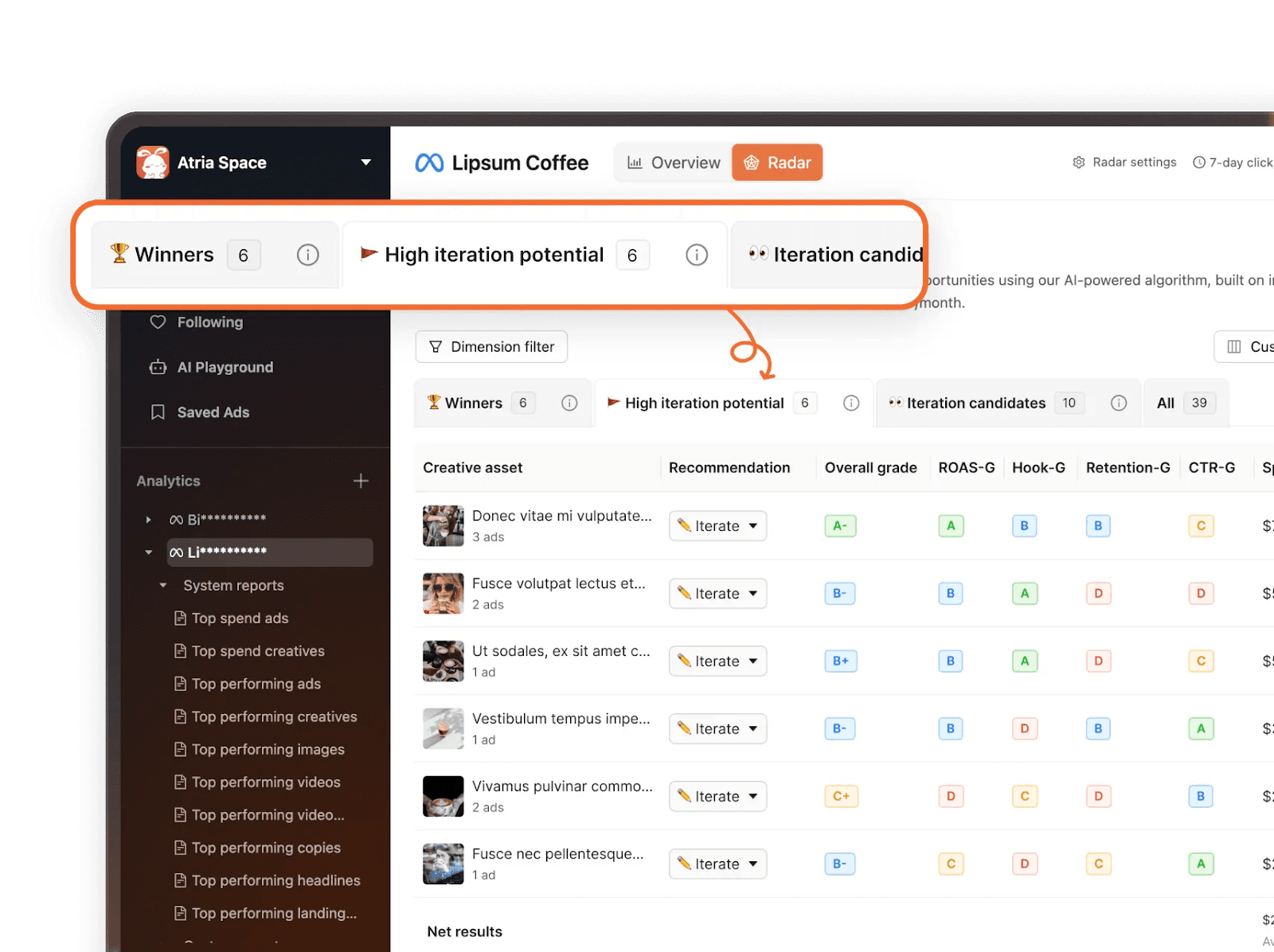
Atria is the only AI advertising platform that truly automates your creative workflow end to end, and uses $2.1B of ad spend data to give you a competitive advantage. While other tools focus on just generating ads, Atria handles everything from research to reporting.
Here's what makes it different:
Full workflow automation. Research competitors, generate concepts, create ads, analyze performance, get recommendations, iterate, all in one platform. You don’t need to switch between 5 different tools.
Manny De Patta, Creative Strategist at Loop Earplugs says “Atria is an essential toolkit in Loop Earplug's ad flywheel. It's the software I rely on to scale our ad creatives and save hours weekly.”
AI recommendations, not just AI generation. Atria analyzes your ad performance and tells you exactly what to do next. Which ads to kill, which angles to double down on, which creative elements are driving results.
Atria's AI tags automatically categorize every creative by hook type, visual style, format, and messaging angle. This means you can zoom out and spot patterns you'd never catch manually.
Maybe your UGC-style videos are outperforming product shots 3:1. Or testimonial hooks convert better than benefit-led ones for your audience. You'll see exactly where your creative diversity is working and where you need more variety.
Competitor intelligence built in. Follow your competitors and see exactly what ads they're running, what hooks they're testing, and what's working.
You might discover that competitors in your niche are shifting to UGC-style content. Or that they’re leading with results in the first three seconds of their ads. You can then use AI ad cloning to adapt their best performers to your brand in seconds.
Smart asset management. Upload your creatives, and Atria automatically tags them with hooks, products, colors, and themes. Search for “blue background coffee mug” and actually find it, even if you never labeled the file.
Batch operations (Coming soon). Push multiple ads to Meta with one click instead of manually uploading each variant.
2. AdCreative.ai
Use case: Small teams that need high-volume creative generation
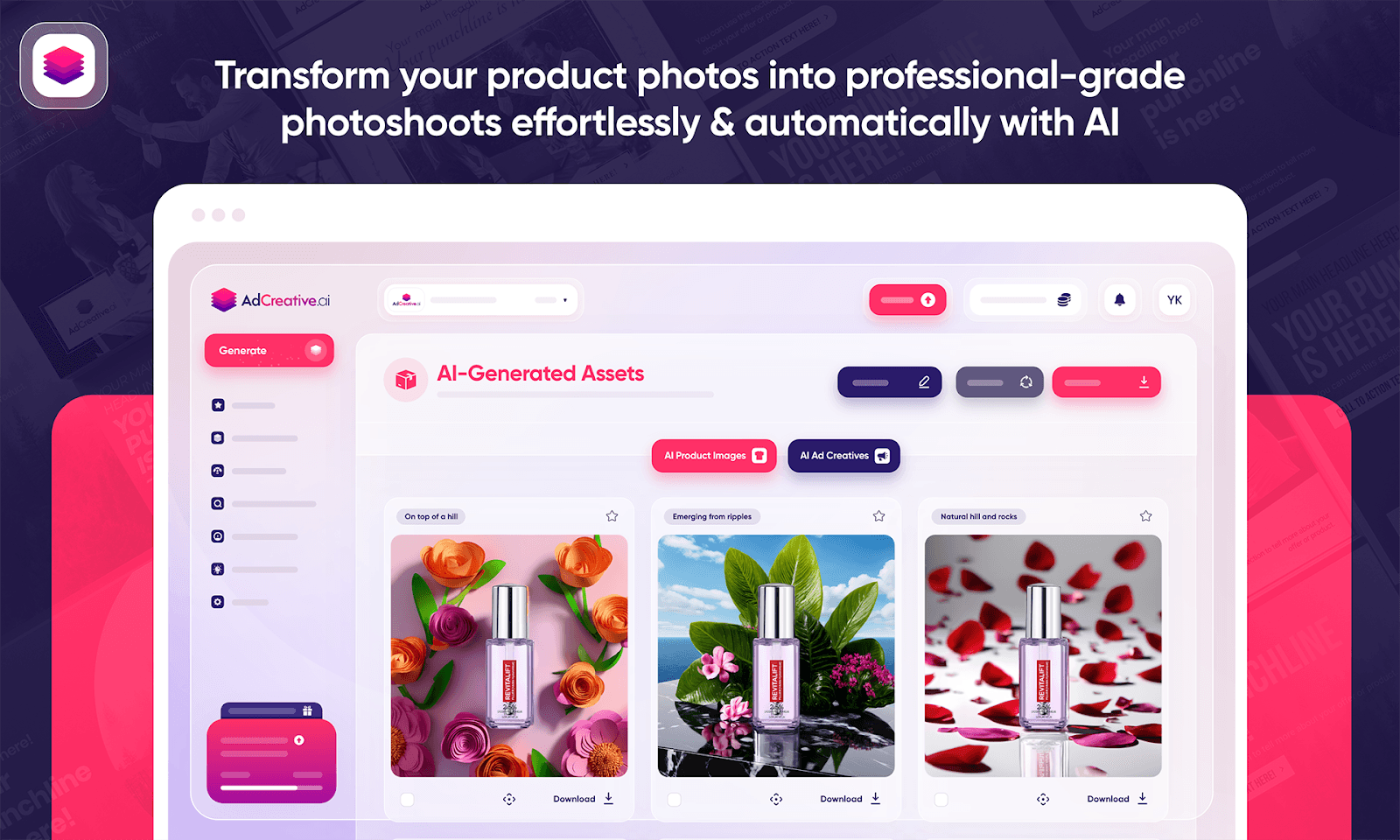
AdCreative.ai is built specifically for generating conversion-focused ads at scale. It creates banners, videos, and copy, then uses AI to score each creative based on predicted performance.
The platform's strength is speed. You can generate dozens of ad variants in minutes, complete with product photoshoots and UGC-style videos. The creative scoring system claims over 90% accuracy in predicting which ads will perform best.
Where it falls short: AdCreative.ai generates ads, but it doesn't help you figure out what to create in the first place. There's no competitor research, no strategic insights, no workflow automation beyond the generation step itself.
If you already know what you want to test and just need volume fast, this is a solid option. But if you need help with strategy and iteration, you'll need additional tools.
3. Madgicx
Use case: Ecommerce brands with $1,000+ monthly Meta spends and teams who are comfortable with a more technical product
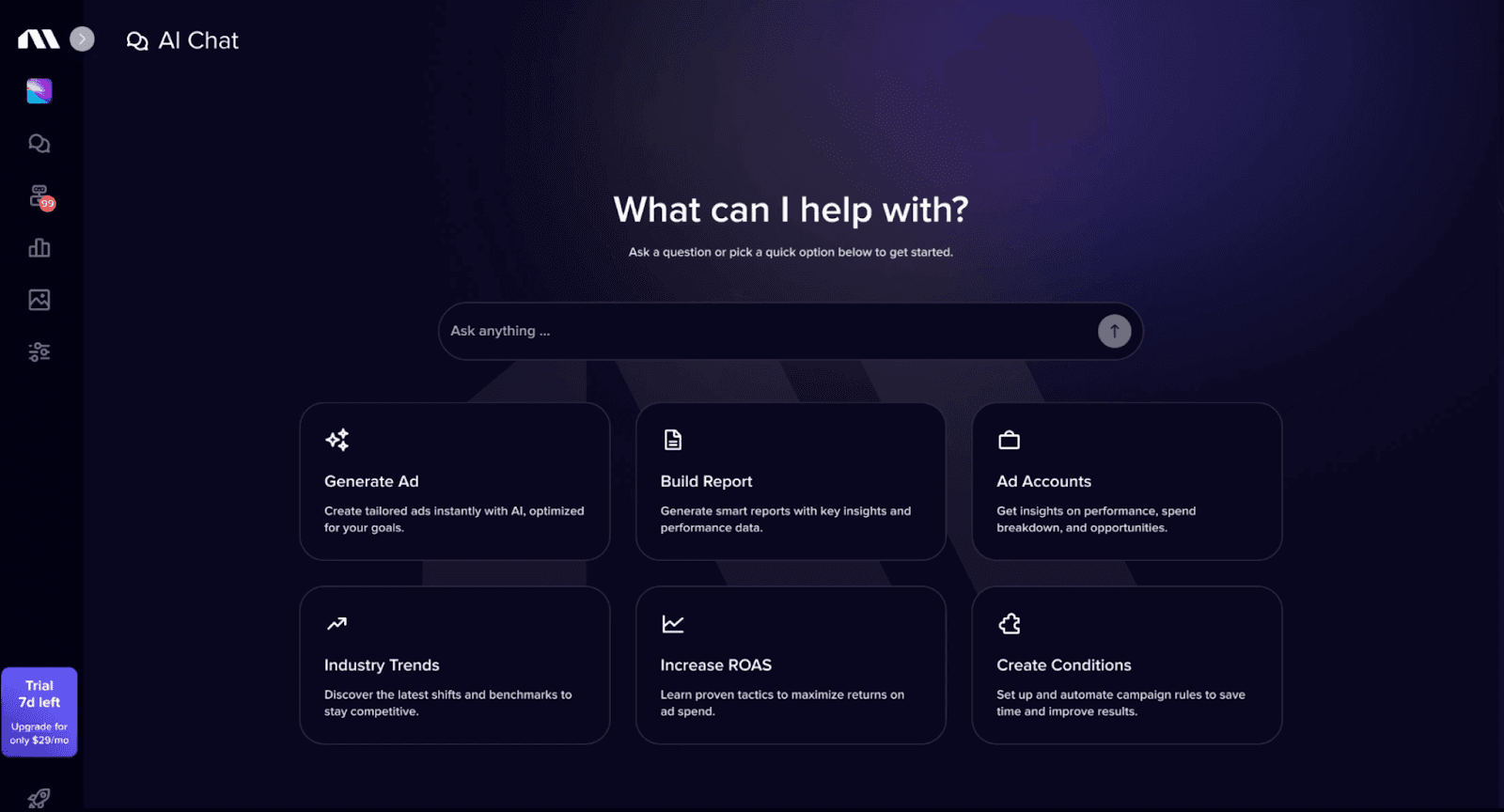
Madgicx is a Meta Ads automation platform that includes creative generation as part of a larger optimization suite. It automatically rotates ads, adjusts bids, and allocates budget based on performance.
The platform integrates directly with Shopify, giving you ecommerce-specific reporting and ad templates. It's designed for brands that want to automate not just creative production, but campaign management as well.
The tradeoff: Madgicx is complex. There's a steeper learning curve than pure creative tools, and the platform is really built for Meta ads specifically. If you're running multi-channel campaigns, you'll need other tools to fill the gaps.
4. Celtra
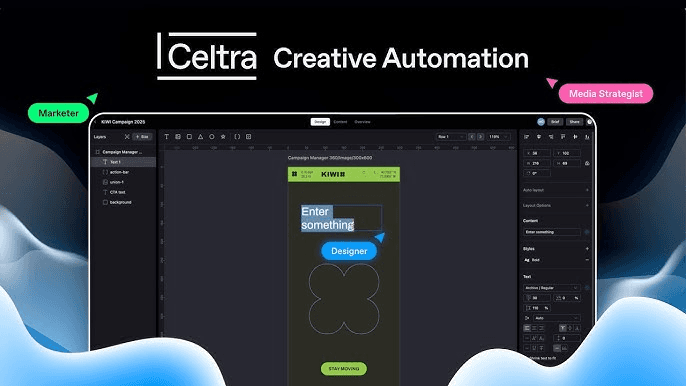
Use case: Brands that need dynamic creative optimization across multiple channels
Celtra is an enterprise-grade platform for creating, customizing, and distributing dynamic ads at scale. It's built for brands running campaigns across display, social, and video simultaneously.
The platform excels at maintaining brand consistency while still allowing for personalization and localization. You can create templates that adapt based on audience, location, product, and more.
Where it makes sense: Large brands with complex creative needs and strict brand guidelines. Where it doesn't: Small teams that need speed over enterprise features. Celtra is powerful, but it's overkill for most ecommerce brands.
5. Predis.ai
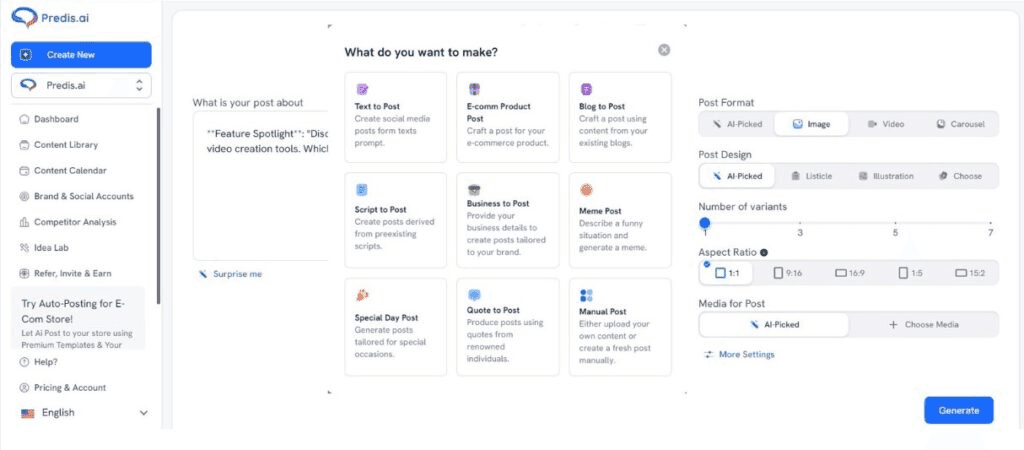
Use case: Small businesses and freelancers who need all-in-one content creation
Predis.ai combines ad creative generation with social media management tools. It creates UGC videos, product videos, social posts, and ad creatives, then helps you schedule and post them automatically.
The platform is designed for small teams that can't afford multiple tools. Instead of separate platforms for creative, scheduling, and analytics, Predis.ai bundles everything together at a lower price point.
The limitation: Jack of all trades, master of none. Predis.ai does a lot, but it doesn't do any one thing as well as specialized tools. If you need basic functionality across the board and have a tight budget, it works. If you need advanced features for ad creative specifically, you'll hit its limits quickly.
What's Next for Ad Creative Automation
Creative automation keeps you alive in the age of algorithmic ad delivery.
Meta, TikTok, and Google aren't going back to the old model where you controlled which audiences saw which ads. The platforms have tasted the conversion rates that come from individual-level creative matching, and they're doubling down.
Success in 2026 comes down to producing diverse, high-quality creative at a pace that matches algorithmic demand. Not the biggest team or the fanciest equipment, but the ability to feed these platforms what they're asking for.
Right now, most brands are stuck. They're either sacrificing quality for quantity (pumping out templated garbage) or sacrificing quantity for quality (making beautiful ads that don't give the algorithm enough to work with).
Platforms that truly automate your creative workflow, like Atria, are the bridge out of that trap. They let you maintain creative standards while hitting the volume and diversity targets that modern ad platforms require.
You can wait another quarter while your competitors figure this out first. Or you can start now.
The creative arms race is here. And it's not slowing down.
Frequently asked questions
Do I need creative automation if I have a design team?
Yes. Creative automation doesn't replace designers, it makes them more effective. Your designers should be focused on strategy and high-impact work, not resizing the same ad 50 times. Automation handles the repetitive execution so your team can do more creative thinking.
Which platform has the best Meta ads integration?
Atria and Madgicx both integrate directly with Meta ads, but Atria's integration covers more of the workflow. Madgicx focuses on campaign management and optimization. Atria handles creative production, asset organization, performance analysis, and batch uploading.
Can creative automation actually improve ad performance?
Yes, when done right. The key is using automation to increase both volume and diversity, not just pump out more of the same ad. Platforms like Atria that combine automation with data-driven insights help you test smarter, not just faster.
How much time does creative automation actually save?
Most teams report saving 4-10 hours per week on creative production alone. When you add in time saved on research, organization, and analysis, it's often 15-20 hours weekly. That's half a full-time employee's workload.
Do I need different tools for images vs. videos?
Currently, yes. Image ad automation is mature and delivers production-ready results. Video automation is improving fast but isn't quite there yet. Most teams use automation for images and UGC-style videos, then handle premium video content separately.